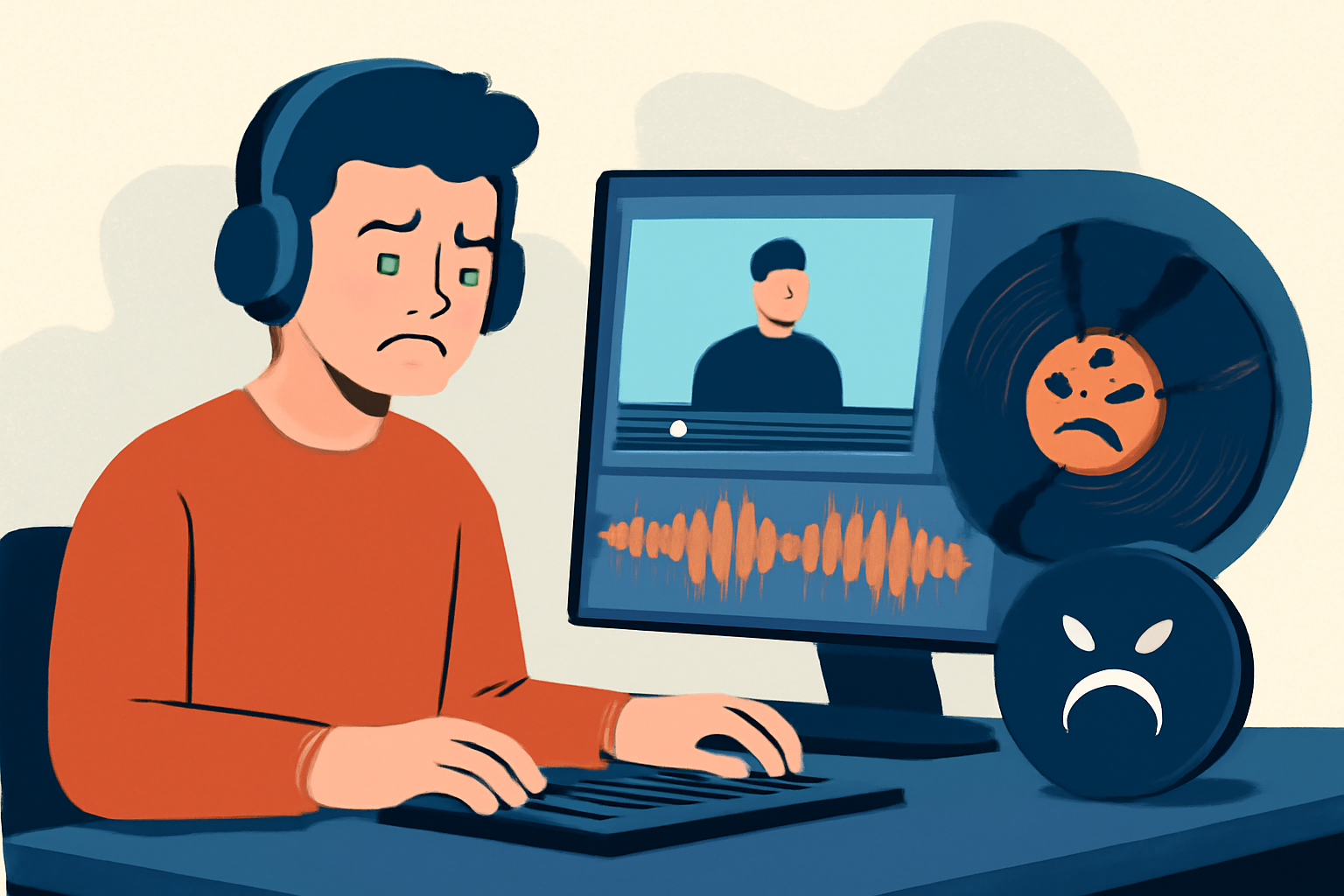


Music does more work in a video than most people realize. It sets the emotional register before anyone has processed a single word, it controls pace, it fills the gaps that would otherwise feel empty, and it's a large part of why a well-made video feels professional rather than amateur. It's also, routinely, the last thing anyone thinks about — chosen in the final ten minutes from whatever's convenient, after days of care spent on everything else.
The result is a specific and common failure: a video that's well shot, well edited, and thoughtfully written, undermined by a track that's fighting it. Music that's too energetic for a serious message, too generic to register as anything, or simply too loud against the voice can take a genuinely good video and make it feel cheap. It's the most impactful element that gets the least attention, which is a strange allocation for something that shapes how the whole thing feels.
Then there's the other problem, which is legal rather than creative: using music you don't have the right to use. Popular commercial music is not free to put in your video, and the consequences range from the video being muted or removed, to the platform giving the advertising revenue to someone else, to genuine legal exposure for commercial work. This catches people out constantly, usually because they assumed that crediting the artist, or using only a short section, or not making money from it, made it acceptable. None of those assumptions is reliable.
Both problems are straightforward to avoid once you know how music licensing actually works and what to listen for when choosing. Here's a practical guide to both — where to get music you can legally use, and how to pick tracks that make your video better rather than worse. One note before starting: I'm not a lawyer, copyright rules vary by country, and licence terms differ between providers, so treat this as a practical orientation and read the specific licence for anything you use.
Key Takeaways
- Music shapes how a video feels before anyone processes the words. It's the highest-impact element that gets the least attention.
- Popular music isn't free to use. Crediting the artist, using a short clip, or not earning money from it does not make commercial music legal to include.
- Licensed libraries are the practical answer. Subscription and per-track libraries exist precisely for this, at prices that work for most projects.
- Read the licence, especially for client work. Commercial use, client ownership, and paid advertising are often covered differently from personal use.
- Choose for the emotion, not the taste. The track's job is to support the message and the edit — not to be a song you personally like.
How Music Licensing Actually Works
The basic principle is simple: recorded music is owned, and using it in a video requires permission from the owners. What makes it feel complicated is that a single song typically involves more than one set of rights — broadly, rights in the underlying composition and rights in the specific recording — which is why properly licensing a well-known commercial track is expensive and administratively involved, and generally out of reach for ordinary projects.
Several widely-believed exceptions do not hold up. Crediting the artist doesn't grant permission; credit is not a licence. Using a short section isn't automatically acceptable, since there's no reliable "safe" duration. Not making money from the video doesn't make it permitted, though commercial use tends to raise the stakes. And having bought the song does not give you the right to include it in a video — purchasing a copy grants you personal listening rights, not synchronisation rights.
The practical consequences vary by platform and situation. On major video platforms, automated systems detect copyrighted music, and the outcome can be that your video is muted, blocked in some regions, taken down entirely, or has its advertising revenue redirected to the rights holder. For a business, there's a further layer: using unlicensed music in commercial work can create genuine liability, and it's the kind of risk a client will hold you responsible for. Since well-priced legal options are readily available, this is an easy risk to simply not take.
Where to Get Music You Can Actually Use
The practical answer for almost everyone is a production music library — services that license music specifically for use in video, either by subscription or per track. These exist precisely for this purpose, the catalogues are large and increasingly good, and the pricing is designed for exactly the kind of work most people are making. For a business producing video regularly, a subscription is usually the simplest solution: pay once, use across projects within the terms.
There are other legitimate routes. Some music is released under licences that permit reuse with conditions attached — often requiring attribution and sometimes restricting commercial use — and these can be genuinely useful, provided you actually follow the conditions rather than assuming "free" means unconditional. Music in the public domain can be used freely, but note that a modern recording of a public-domain composition is usually itself protected, so the recording matters as much as the piece. And commissioning original music, while more expensive, gives you something distinctive and unambiguous rights, which is worth considering for flagship work.
Whichever route you take, the essential habit is reading the licence rather than assuming, because terms differ meaningfully between providers and the differences matter. The things to check are whether commercial use is permitted, whether client work is covered (some licences are personal to you and don't extend to work you deliver to a client), whether paid advertising is included, whether there are limits by platform or audience size, whether attribution is required, and how long the licence lasts. Keep a record of what you licensed and when, which takes seconds and is exactly what you'll want if a claim ever appears.
Choose for the Emotion, Not Your Taste
With the legal side handled, the creative question is what actually makes a track right — and the most common mistake is choosing music you like rather than music the video needs. Your personal taste is close to irrelevant here. The track's job is to support the message, match the emotional register, and serve the edit, and a great song that pulls in a different direction than your content is a worse choice than an unremarkable one that fits.
So start from the feeling the video should produce. A piece meant to be reassuring and trustworthy needs something calm and warm, and putting driving energetic music underneath it creates a mismatch the viewer feels without being able to name — they'll simply find the video slightly off. Serious content with upbeat music reads as tonally confused; energetic content with sedate music feels flat. Naming the intended emotion before browsing tracks makes the search enormously faster and the result better, because you're searching against a criterion rather than reacting to whatever plays.
Pace matters as much as mood. Music that moves at a different speed from your edit fights it constantly, while music whose rhythm roughly matches your cutting pace makes the whole thing feel intentional. If you can, choose the track early enough to edit to it, because cutting on the music's rhythm is one of the cheapest ways to make an edit feel professional — a technique that costs nothing and improves almost any piece. This is the same category of unglamorous craft decision as getting your audio right: invisible when done well, and immediately noticeable when it isn't. [BACKLINK PLACEHOLDER → suggestion: internal link to article #54, why better audio and lighting beat a better camera / the unglamorous choices that determine how professional something feels]
🎬 Embed a short comparison of the same edit under three different tracks — one too energetic, one too generic, one that fits — showing how much the music changes the meaning.
Get the Levels Right
The most frequent technical failure with music is simply having it too loud. Music competing with a voice makes the voice harder to follow, and since the voice is usually carrying the actual content, that's a direct cost to comprehension. Under dialogue or narration, music should sit clearly underneath — present enough to shape the mood, quiet enough that it never makes anyone work to hear the words. When in doubt, lower it, because almost nobody complains that background music was too quiet and plenty of viewers abandon videos where they can't hear the speaker comfortably.
Use volume dynamically rather than setting it once. Music can sit louder in sections with no speech — an opening, a transition, a closing sequence — and duck down whenever someone is talking, which most editing software can do automatically or with a couple of keyframes. That variation is a large part of what makes music feel woven into a video rather than laid over it, and it's a small amount of work for a noticeable improvement.
Endings deserve specific attention, because an abrupt music cut at the end of a video is jarring and surprisingly common. Either fade out deliberately, find a natural resolution point in the track, or cut on a beat that feels conclusive. And know when to have no music at all: silence is a legitimate choice, particularly for serious content or moments meant to land with weight, and constant wall-to-wall music can make a video feel relentless. Music is a tool for shaping attention, which means it works better with contrast than with continuous presence.