

A few months ago, we got a project inquiry from someone I would have called a "creator" — a single-person operation with about 400,000 followers on Instagram who built her audience through cooking content. She was not looking for content from us. She was looking for production support for her brand deals. She had four sponsors lined up for the next quarter, each requiring different deliverables across different platforms, and she needed a team that could handle the post-production while she focused on the cooking, the relationships, and the creative direction.
I have thought about that conversation a lot since. Not because it was unusual — we have done variations of that work for several creators since — but because the structure of her operation, when I actually looked at it, was indistinguishable from a small agency. She had clients (the brands). She had a roster of deliverables. She had recurring revenue, project-based revenue, and a small team of contractors she managed. She had cash flow problems, scaling questions, and the same operational tensions every small studio owner experiences. The only meaningful difference between her business and ours was that the asset she sold was her own audience and creative judgment, while we sold the audience and creative judgment of others.
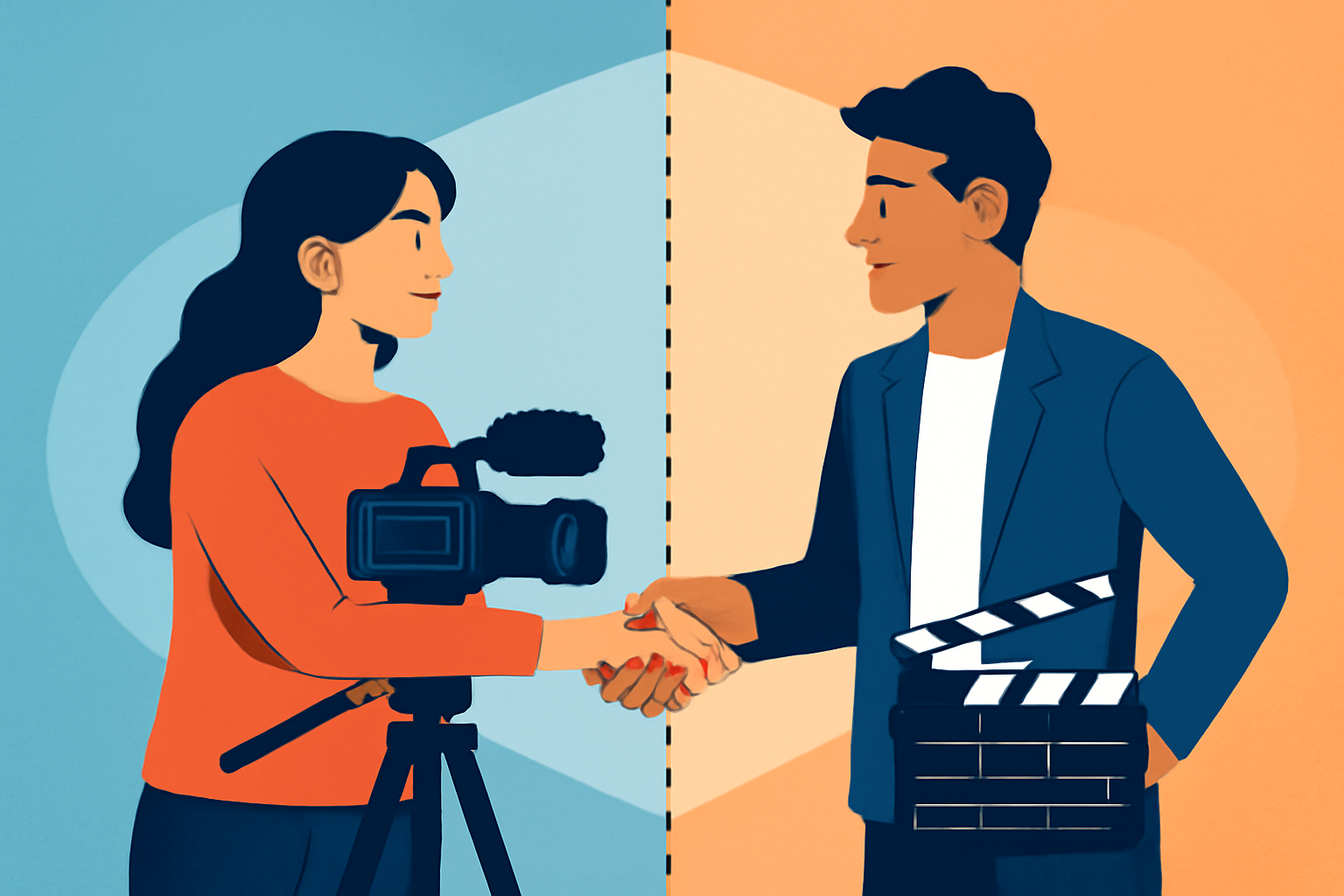
This is the convergence almost nobody in either industry is naming. The creator economy and the agency industry have spent the last decade describing themselves as separate categories, often as competitors. They are increasingly becoming the same kind of business, with different surface labels and converging underlying mechanics. The line between "creator with a small team" and "agency with a founder personality" is dissolving in real time. The published conversation in both industries treats this as a curiosity. It is, structurally, much more than that — and the operators who understand the convergence early will be positioned in ways the operators who keep treating the categories as distinct will not.
Key Takeaways
- Creators are increasingly running operations that look like small agencies. Production teams, sponsor relationships, retainer-style brand deals, cash flow management — the surface layer says "creator" but the underlying operation is structurally agency-like.
- Agencies are increasingly building owned audiences and producing content for themselves. Founder-led content, thought leadership, owned distribution channels — the surface layer says "agency" but the underlying activity is structurally creator-like.
- The convergence is being driven by structural forces, not strategy. AI tools, accessible distribution platforms, the unbundling of traditional agency services, and the need for both categories to own demand are pushing both kinds of businesses toward the same shape.
- The label matters less than the underlying capability stack. What makes a business durable in 2026 is not whether it identifies as a creator or an agency, but whether it has the right combination of audience, judgment, production capacity, and accountability for outcomes.
- The category confusion is the opportunity. Operators who position themselves explicitly in the convergence — neither pretending to be a traditional agency nor a traditional creator — are addressing a market the legacy framings cannot reach.
What Creators Are Doing That Is Agency Work
If you look closely at any creator past the early stage, you see an operation that increasingly resembles a small agency. The cooking creator I mentioned at the start of this article is a representative example, not an unusual one. Once a creator's audience reaches a certain size, the business they run starts to take on agency-like characteristics whether or not the creator describes it that way.
They build teams. A creator with a sustained business almost always has editors, producers, social media managers, and often someone handling sponsor relationships. The team size varies — some creators have one or two collaborators, some have ten or twenty — but the structure of a creator-with-team is operationally a small studio.
They manage clients. Brand sponsors are clients. The contracts have scopes, deliverables, timelines, and approval workflows. The creator may not call them clients, but the relationship has all the same friction points: scope creep, revisions, payment delays, performance accountability.
They run portfolios of work. A creator with four active brand deals is managing four concurrent projects with different requirements. This is the same operational reality a small agency with four clients lives with — context-switching, prioritization, calendar management, all the same coordination challenges.
They handle the same cash flow problems. Brand deal payments come in batches with long delays. Recurring revenue is rare. Cash flow planning is just as critical for creators at this scale as it is for small studios, and the same operational disciplines (buffer reserves, payment terms, invoice timing) apply. [BACKLINK PLACEHOLDER → internal: link to article #6 (cross-border payment reality) — both pieces document the operational reality of running a small business through cross-border or multi-client payment cycles.]
The most successful creators have effectively become CEOs of small media companies, with all the operational complexity that implies. The "creator" label, applied to these operations, has become a polite fiction that hides the actual structure of the business. [BACKLINK PLACEHOLDER → external: a credible report on the maturation of the creator economy as a business category, e.g. from SignalFire's State of the Creator Economy, a16z's creator economy coverage, or a respected business publication's analysis. Aligns with the $4–10 CPC on creator tools and marketing platforms.]
What Agencies Are Doing That Is Creator Work
The same convergence runs in the opposite direction. Agencies are increasingly behaving like creators in ways that would have been unusual five years ago.
They publish their own content. A growing share of small and mid-sized agencies maintain owned content channels — blogs, LinkedIn pages, YouTube channels, newsletters — that look structurally identical to creator media operations. The agency publishes regularly, builds audience over time, and treats the owned channel as a primary acquisition lever. The article you are reading right now is an example. MLHMTECH publishing essays under Tasfin's byline is, in form, no different from a creator publishing essays under their own name. The only meaningful distinction is that the agency hopes the audience eventually buys services rather than buying a course or a brand deal.
They build founder personalities. Agency founders increasingly function as creator-style brands. Gary Vaynerchuk built VaynerMedia largely on his personal audience. The next generation of agency owners is building smaller versions of the same dynamic on LinkedIn, X, and YouTube. The founder personality becomes the primary acquisition channel for the agency, which means the founder is, in operational terms, also a creator.
They sell products as well as services. Templates, frameworks, courses, paid newsletters, productized scopes — the lines between agency services and creator products are blurring. A small studio that sells a $499 brand audit template alongside its $5,000 monthly retainer is, in product mix, indistinguishable from a creator who sells a $499 course alongside brand deal income.
They use creator distribution playbooks. The way successful agencies build awareness now looks like the way creators do. Consistent publishing on owned channels, audience cultivation over time, evergreen content libraries, email list building. The marketing playbooks have converged because the distribution environment has converged.
Why The Convergence Is Happening
This is not happening because creators decided to become agencies or agencies decided to become creators. It is happening because the structural environment both kinds of businesses operate in has changed in ways that push them toward the same shape.
Production tools have democratized. AI tools, accessible editing software, low-cost camera equipment, and improved generative tools mean that small operations can produce work at quality levels that used to require larger teams. A single creator with the right toolkit can produce work that competes with a 10-person agency. A small agency with the same tools can produce work that competes with a 50-person agency. The capability gap that used to distinguish the categories has collapsed. [BACKLINK PLACEHOLDER → internal: link to article #16 (AI inside studio) — both pieces describe how the production layer of creative work is changing.]
Distribution is no longer an agency monopoly. Two decades ago, getting work in front of an audience required relationships with publishers, broadcasters, or media buyers — relationships that agencies owned. Today, an audience can be built on free platforms by anyone with consistency and judgment. The distribution layer that used to favor agencies has democratized in favor of anyone willing to publish.
Both categories need owned demand. Agencies that relied on referrals and outbound sales are increasingly building content channels to generate inbound demand. Creators that relied on platform algorithms are increasingly building owned audiences (newsletters, communities) to insulate against algorithm changes. The pressure to own demand has pushed both categories toward the same kind of owned-audience strategy.
The economic models are converging. Creators monetize through brand deals (which are structurally similar to client retainers), products (similar to productized services), and direct audience monetization (subscriptions, communities). Agencies monetize through retainers (similar to brand deals), products (templates, courses), and increasingly through content monetization on their owned channels. The economic stacks of the two categories are no longer cleanly distinguishable. [BACKLINK PLACEHOLDER → external: a current analysis of creator economy revenue diversification, e.g. from ConvertKit (Kit), Beehiiv, or Substack's published research on creator income mix.]
The Skill Stack Is Converging
The skills required to succeed as a creator-with-team and as an agency-with-audience are increasingly the same skills.
Creative judgment. Both need it. Both pay for it.
Production capacity. Both need a way to produce work consistently, whether through internal teams, contractors, AI tools, or some combination.
Audience understanding. Both need to know who they are talking to and why their audience cares.
Operational discipline. Both need to manage cash flow, contracts, scope, team coordination, and the inevitable friction of running a small business.
Distribution strategy. Both need to think about how their work reaches the audience that will buy from them.
Accountability for outcomes. Both need to deliver results that justify the relationship continuing.
A decade ago, these skill stacks were genuinely different. An agency was about strategy and production. A creator was about personality and audience. The skill stacks have converged because the work has converged. The successful operators in both categories now run businesses that require all six of the above, regardless of which side of the convergence they originated on.
What This Means For Both Sides
If you are a creator past the early stage, the most useful realization is probably that you are running a small business — not just being a creator — and that the operational disciplines of small business management (margin, hiring, cash flow, scope management) matter as much as creative output. The successful creators I have watched mature into durable businesses almost all crossed this realization at some point. The ones who refused to — who kept treating themselves as creators rather than operators — usually plateaued at a smaller scale than their audience would have supported.
If you are an agency owner, the most useful realization is probably the inverse. You are not just an agency; you are also a media operation, and the disciplines of audience building (consistency, owned channels, voice, longevity) matter as much as the operational disciplines you already understand. The agencies I have watched grow most strategically over the last few years almost all started treating their content output as seriously as a creator treats it — with editorial calendars, audience strategy, consistent publishing, and content as a core function rather than an afterthought. [BACKLINK PLACEHOLDER → internal: link to article #15 (agency unbundling) — both pieces describe the structural shifts reshaping the agency industry.]
The deeper realization, for operators in both categories, is that the surface label is becoming less meaningful than the underlying capability stack. The market does not really care whether you call yourself an agency or a creator. The market cares whether you can do the work, attract the audience, and deliver the outcomes. Spending time defending the categorical purity of either label is, in 2026, a less useful activity than figuring out which capabilities you actually have and which you need to build next.
The Category Problem
There is a practical complication created by this convergence: positioning becomes harder, not easier. A business that operates in the converged middle — too established to be a creator, too founder-led to be a traditional agency — has no clean category to market itself within. The legacy frames do not quite fit, and the market does not yet have a stable replacement frame.
The honest move, in my experience, is to stop trying to fit into the old categories and instead describe the actual business plainly. We are a small studio that produces video content for brands and publishes our own thinking under the founder's name. We are a creator who has built a small team to produce work for sponsors at higher quality than I can produce alone. These descriptions are awkward because they do not fit existing labels. They are also more accurate, and the market tends to respond better to accurate descriptions than to label-fitting fictions.
The next generation of marketing labels will be invented by the operators who currently work in the convergence and need new language to describe themselves. The published vocabulary is two or three years behind the actual market, which is the gap every emerging business category goes through during its formation phase.