


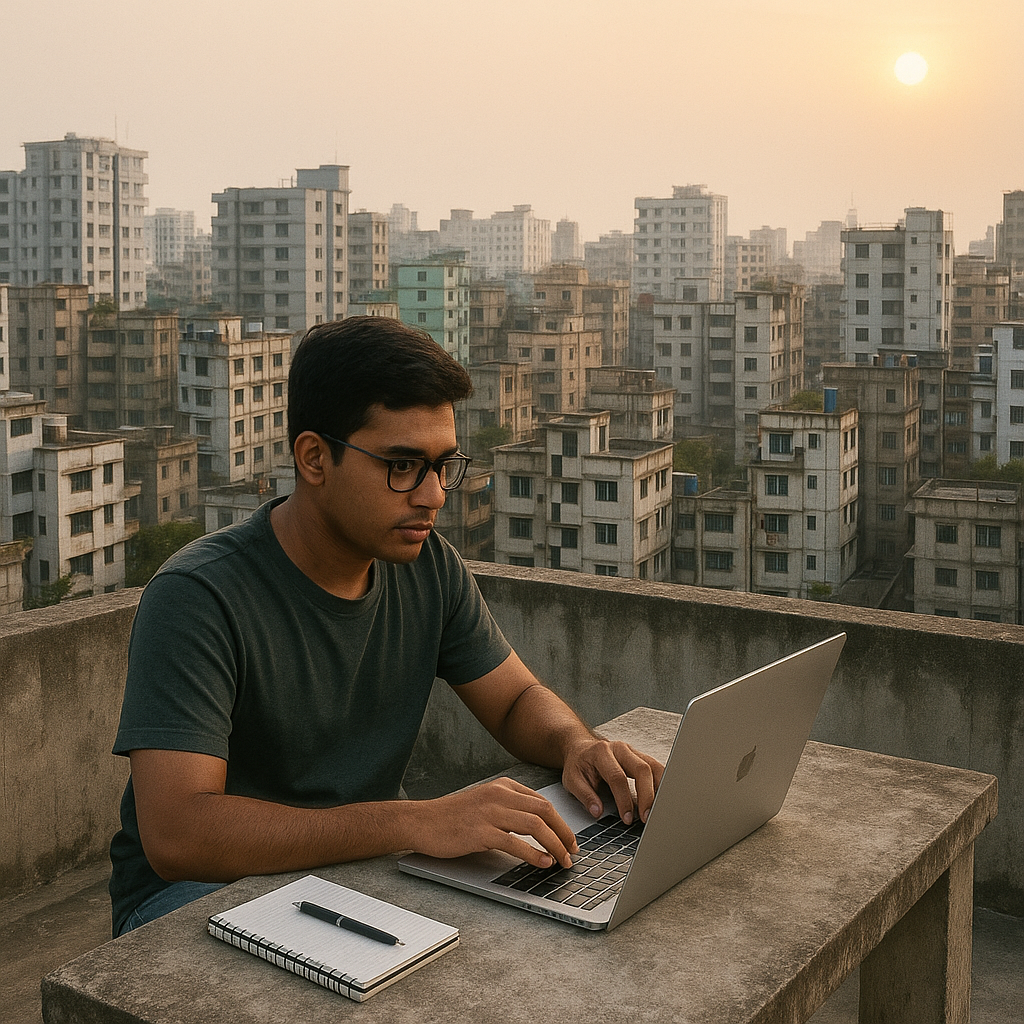
A brief landed on my desk last year for a small restaurant group in London. The owner wanted social content that captured the feeling of "Soho on a Saturday night." I read that line three times. I have never been to Soho. I had never been to London at all. I was reading the brief at 11 p.m. from a third-floor apartment in Kafrul, a residential neighborhood in north Dhaka, with the muezzin's call carrying through the open window and the lights of the city stretching out toward the airport. Eight thousand kilometers from the Saturday night the brief was asking me to understand.
The instinctive reaction — mine, the client's, everyone reading this — is that distance is a problem to overcome. The whole conversation about international outsourcing is shaped around how to minimize the gap between a brand and the people producing its content. Use better tools. Faster communication. More reference material. Closer time zones. The implicit assumption is always that proximity equals understanding, and that any geographic or cultural distance between editor and client is a deficit you spend the engagement working to neutralize.
After three years of editing content for restaurants in London, fintech apps in Berlin, fitness creators in Los Angeles, and direct-to-consumer brands across the United States — all from Dhaka — I do not believe that assumption anymore. The same dynamic shows up in why more marketing rarely fixes a positioning problem. Distance is real. But it is rarely the problem people think it is. And in a specific, observable way that almost nobody writes about, cultural distance can actually produce sharper, more deliberate creative work than proximity would have.
This article is the case for that argument. Written from the position only a Dhaka-based agency can write it from — from inside the work, not observing it from outside.
Key Takeaways
- The "proximity equals understanding" assumption is wrong more often than people realize. Local agencies fall into the curse of knowledge — they assume what is obvious to them is obvious to the audience.
- Cultural distance forces explicit communication. When you cannot assume, you ask. When you ask, the brief gets sharper, the strategy gets clearer, and the work gets more deliberate.
- The disadvantages of distance are real but narrow. Time zone friction, visual culture references, and trust-building all take longer. None of these are unsolvable, and most are dramatically smaller problems than the proximity argument suggests.
- Working across cultures builds creative discipline a local team rarely develops. Every reference has to be verified, every assumption tested, every cultural cue translated rather than absorbed.
- International clients are often paying their local agencies for assumptions, not for work. The same hourly rate buys research from a Dhaka studio and intuition from a London one. The research output is frequently more accurate.
The Brief That Made Me See It
When that London restaurant brief arrived, I did what any honest editor in my position would do. I looked up Soho. I watched four hours of Saturday night vlog footage. I read three Time Out articles about Soho's dining scene. I asked the client three follow-up questions — what kind of crowd, what time of night, what does the lighting feel like at the front versus the back of the restaurant. Each question slightly annoyed me to ask because it felt like exposing my ignorance. Each answer made the brief dramatically clearer.
Two weeks later, the client said something that has stayed with me. They told me the videos felt "more Soho than the ones the previous agency made." The previous agency was in London. They had been to Soho. They had walked through it on Saturday nights. And their work, the client said, had felt vaguely off — slightly too polished, slightly too corporate, missing the specific texture of the actual neighborhood.
I have thought about that comment a lot. The London agency had every advantage. They knew Soho directly. They could have visited the restaurant on a Saturday night to see it themselves. They had the proximity that the whole international outsourcing conversation treats as the deciding factor. And they made work that was technically competent but somehow generic.
The Dhaka studio, eight thousand kilometers away, made work the client described as more accurate to the place.
Once I noticed this, I started seeing the pattern everywhere.
What Distance Actually Forces
The mechanism behind the pattern is something psychologists call the curse of knowledge. When you know something deeply, you lose the ability to remember not knowing it. A London editor who has lived in Soho for a decade cannot fully see Soho anymore — it has become invisible to them in the way that everything familiar becomes invisible. They make work that assumes the audience already understands what Soho feels like, because to them, it is just obvious.
[BACKLINK PLACEHOLDER → external: research on the curse of knowledge, e.g. Chip and Dan Heath's "Made to Stick" summary on heathbrothers.com or thedecisionlab.com]
A Dhaka editor cannot make that assumption, because Soho is not obvious to them at all. So they ask. They research. They look at the actual visual texture of the place. They make decisions deliberately rather than automatically. The work that comes out the other side is shaped by all of that conscious processing — and the result is often something that captures the place more sharply than a local production would, because every choice was made on purpose.
This is the invisible benefit of cultural distance. It forces a kind of editorial discipline that proximity actively dissolves. When you cannot rely on intuition, you have to rely on research. Research is slower. It is also more reliable. And in a creative industry that runs almost entirely on intuition, that reliability shows up in the final output as a kind of intentionality that audiences feel without being able to name.
The Curse Of Knowledge Inside Local Agencies
There is a specific pattern I see in work produced by local agencies for local clients, and once you notice it you cannot unsee it either. The work tends to be technically smooth but strategically vague. It looks correct. It uses the right references. It moves at the right pace. But it does not say anything specific about the actual audience.
This is because the local agency, working from inside the culture, never had to ask the strategic questions. They never had to write down what a Sunday roast actually means to a 32-year-old London professional, or why a gastropub crowd is different from a wine bar crowd. They absorbed all of it. So when it came time to produce content, they pulled from that absorbed understanding — and produced something that feels right without anyone being able to explain why.
A Dhaka studio working on the same brief has to write all of it down. We have to ask the client what the gastropub crowd actually wants. We have to verify our assumptions about Saturday night dress codes. We have to confirm the price point and the political register and the demographic. And in the act of writing all of that down, we end up with something the local agency rarely produces: a documented, defensible strategic argument about what the work is supposed to do.
That documentation is the deliverable. The video is just its expression. It is the same reason clients hire you to stop thinking about it — the thinking is the product.
Where Distance Is Actually A Problem
I do not want to overstate this argument. Distance is not always an advantage. There are real costs, and pretending they do not exist would be dishonest.
Time zone friction is real. A six-hour gap between Dhaka and London means that a question asked at 5 p.m. my time is being answered at 11 a.m. the next day. Over a six-week project, that compounds into a few days of additional cycle time. The fix is structural rather than personal — building briefs and feedback rounds around the time zone gap, batching questions, and being deliberate about which conversations need real-time and which can run asynchronously.
Visual culture references need translation, not just understanding. When a client says "make it feel like Chef's Table but for a casual restaurant," I have to watch Chef's Table if I haven't already. When they reference a specific UK ad campaign that influenced their brand identity, I have to track it down. Local agencies skip this step because they already know the references. The cost is mine to absorb, and I budget for it in every project.
Trust takes longer to build. International clients understandably want to verify that an agency they have never met can deliver. The first project with a new client is always slower than subsequent ones because trust has to be built across distance with no shared context. I have found that the only way to handle this is to over-communicate during the first engagement — more updates, more interim drafts, more transparent process — and let the work itself build the trust the relationship hasn't had time to develop yet.
These costs are real. They are also smaller, in practice, than the proximity argument assumes. None of them are dealbreakers. Most can be neutralized with intentional process design. And they are usually outweighed by the strategic discipline that distance forces.
The Money Side Nobody Talks About
There is also a practical reality to this conversation that most articles politely avoid. International clients hiring a Dhaka studio for content work usually pay between 30 and 60 percent of what they would pay a comparable London agency for the same scope. [BACKLINK PLACEHOLDER → external: international payment / fintech resource, e.g. Payoneer's or Wise's blog on cross-border agency payment] This is sometimes framed by Western clients as "saving money," and sometimes framed by South Asian agencies as a kind of structural exploitation, and both framings miss the more interesting truth.
What the price difference actually buys, when the work is good, is the same thing the higher price would have bought — but with an extra layer of strategic documentation that the local agency would not have produced because it did not need to. The client pays less and gets a more deliberate strategic process. The agency charges what its operating costs allow and delivers work that is often sharper than the comparable Western output. The economic asymmetry is real. The quality asymmetry, in many specific cases, runs the opposite direction from what people assume.
I am not arguing that South Asian rates are correct or that Western rates are inflated. I am arguing that the assumption "you get what you pay for" is doing a lot of work in this conversation that it cannot actually carry. Sometimes you get more than you pay for. Sometimes you get less. The geographic price of the work is a poor signal of its quality.
What This Means For International Clients
If you are a brand outside South Asia considering hiring a Dhaka or Manila or Lagos-based studio for content work, the question worth asking is not can they understand my market. They can, often more deliberately than a local agency can. The question worth asking is do I want a partner who is going to produce a documented strategic argument for the work, or do I want a partner who is going to make work that intuitively feels right without being able to defend it? Both are valid choices. They produce different things.
The hidden cost of hiring locally is that you may be paying for assumptions dressed as expertise. The hidden cost of hiring remotely is that you have to spend more time at the front of the engagement defining what you actually want. [BACKLINK PLACEHOLDER → internal: link to article #2 (in-house vs agency decision psychology) — relates to how clients evaluate sourcing decisions] Both costs are real. Neither is universally worse.
What I would push back against — strongly — is the assumption that physical proximity to a market is the same thing as creative understanding of it. The two are related but not identical, and in many of the projects I have worked on, the second one has belonged to people who have never set foot in the city they were producing for.
🎬 Embed a short reflection on the experience of producing London-targeted content from Dhaka and the discipline distance imposes.
If this way of working resonates, the rest of our thinking lives at MLHMTECH — and you can follow along on YouTube.