

A few months ago I was scrolling LinkedIn when a post from a small London-based creative agency caught my eye. They were proudly sharing a campaign video for a UK brand — strong work, well-paced, the kind of polished short-form output that wins awards. The post celebrated their "in-house editing team." The gap between the pitch and the reality is the same one we explored in The Pitch Is a Performance. Onboarding Is the Truth. In the comments, the founder thanked the team by first name.
I had seen that video before. The pacing, the specific transition style, the way the b-roll was layered against the voiceover — I knew where it had been edited. Not because I had any direct knowledge of the project, but because the editing was so identifiable as the work of a specific studio in Dhaka that I would have placed money on it. I cannot prove the connection. I do not need to. The pattern is so widespread now that the question of whether a particular London agency's "in-house team" is actually in London is statistically not the way to bet.
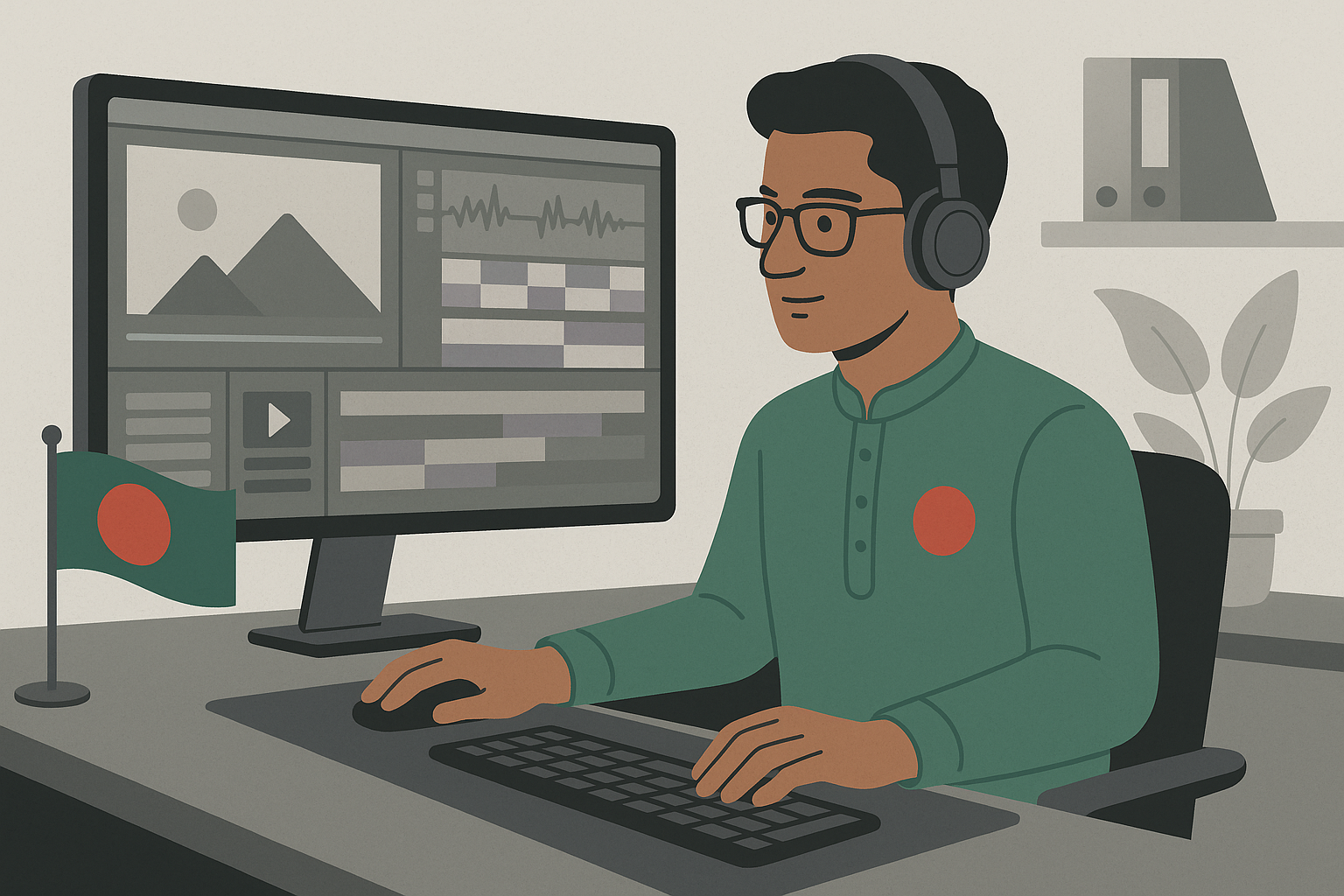
This is the part of the global creative industry that almost nobody writes about honestly. There is a structural economy in which video editors in Bangladesh, the Philippines, India, and a handful of other countries do a meaningful portion of the post-production work credited to studios in the United States, the United Kingdom, and Western Europe. The work is excellent. The pay is a fraction of the local rate. The editor's name does not appear in any credits. The arrangement is legal, normal, and almost completely invisible to the clients on the other end of it — the same dynamic we unpack in The Agency Model Is Being Unbundled In Real Time.
I am writing this as someone who has worked inside this economy for years, as a Dhaka-based agency that has been both the white-label provider and, more recently, a direct contractor. I am not writing it to complain. The arrangement is legitimate, both parties usually benefit, and the invisibility is partly a feature of the model rather than a moral failure. But the fact of it deserves to be said out loud. A generation of editors here is doing some of the best post-production work being made anywhere in the world, and almost no one outside this industry knows we exist.

Key Takeaways
- The white-label economy is real and structural. A meaningful portion of post-production work credited to Western studios is executed by editors in South Asia, Southeast Asia, and parts of Africa.
- Bangladesh has become a center of this work for specific, identifiable reasons — not by accident, and not just because of cost. English education, a young tech-fluent generation, accessible tools, and a thriving self-taught tutorial culture have produced an entire generation of capable editors.
- The arrangement is legal and often mutually beneficial. White-label is a normal industry model. The visibility problem is structural rather than ethical.
- The economic asymmetry is the part worth examining honestly. A Dhaka editor producing work credited to a London studio typically earns 20 to 40 percent of what the studio bills for it. The math is not exploitative on its face, but it is worth knowing.
- The invisibility hurts the next generation of editors here. Without portfolios, credits, or industry recognition, talented editors in Bangladesh cannot transition out of being subcontractors and into being studios in their own name.
What "White-Label" Actually Means
Before going further, it is worth defining the model clearly, because most of the published material on white-label video editing is written by the companies selling the service, and the framing is unsurprisingly favorable to them.
White-label means a studio (the "agency of record") signs a contract with a client and then subcontracts the actual production work to another studio (the "production partner"). The agency of record keeps the relationship, the credit, and a significant margin. The production partner does the work and is contractually prohibited from claiming it as their own. The client usually does not know the production partner exists, and contractually, the production partner cannot tell them.
This is not unique to video editing. Architecture firms do it. Law firms do it. Advertising agencies have done it for decades. The model is legitimate and often produces better outcomes for clients than insisting on full in-house production at a single studio. There are real efficiencies in specialization.
What is specific to the current moment is that the production-partner side of this equation has shifted geographically. The post-production layer of the global creative industry now runs significantly through Dhaka, Manila, Lagos, Karachi, and a handful of other cities — and the white-label structure means almost nobody outside the industry knows it. [BACKLINK PLACEHOLDER → external: a credible piece on the global outsourcing economy or white-label services, e.g. from Harvard Business Review, MIT Sloan, or a fintech publication's analysis of the global gig economy.]
Why Bangladesh Specifically
There is a tendency in international coverage of South Asian creative work to attribute everything to one factor: cost. The honest answer is more interesting and more structural. Bangladesh has become a center of world-class video editing for at least five specific reasons that have very little to do with price.
English-medium education in the relevant generation. A meaningful portion of urban Bangladeshi millennials and Gen Z received their schooling in English-medium institutions, with access to Western educational content from elementary age. The cultural and linguistic gap between a 25-year-old editor in Dhaka and a 25-year-old client in London is smaller than the surface geography suggests.
A young, tech-fluent population. Bangladesh has a median age in the mid-twenties. The generation now doing this work grew up with YouTube as a primary educational medium, Adobe Premiere as a default tool, and global content as their cultural reference set. They learned editing the same way the best editors in any country learned it: by watching, copying, and iterating, often from age fourteen onward.
A thriving self-taught tutorial culture. Bengali-language YouTube channels dedicated to video editing now have hundreds of thousands of subscribers. There is a domestic ecosystem of tutorials, community forums, and mentorship that runs entirely in Bengali and produces editors who have spent more time studying their craft than most formally educated equivalents in the West. This is the part of the equation that is genuinely uncredited and almost invisible to outsiders.
Lower cost of practice. The cost of living in Dhaka makes it possible to spend two or three years learning a craft before earning seriously from it. A 19-year-old in Dhaka with a laptop and an internet connection can practice fifty hours a week without immediate economic pressure to monetize. The same 19-year-old in London usually cannot. The result is a generation that arrives at professional capability with significantly more practice hours behind them.
Time zone overlap. Dhaka is six hours ahead of the United Kingdom and roughly ten or eleven hours ahead of the United States East Coast. This sounds like a disadvantage and is occasionally one, but for asynchronous post-production work, it produces a structural benefit: the Western client sends footage at end-of-day, the editor in Dhaka works during their normal hours, and a first cut is ready by the next Western morning. The overnight turnaround is not a heroic effort. It is just two business days running in parallel.
None of these factors are about being cheap. They are about being structurally well-positioned to do this work. The cost difference exists and matters, but it is not the only reason — and pretending it is misses what is actually happening here.
What "Never Credited" Means In Practice
This is the part of the article that is easy to misread, so I want to be precise. White-label editors in Bangladesh do not appear in the credits of the work they make. Their names are not on portfolio pages. They cannot, contractually, point a future client to a piece of work and say I made that. When awards are won, the agency of record collects them. When the work goes viral, the agency of record gets the attention.
This is the model the editor agreed to. They signed the contract knowing this. The pay reflects the absence of credit. The arrangement is not deceptive — it is the explicit structure of the deal. Saying any of this is not a complaint about the arrangement.
What is worth examining is what the cumulative invisibility means at the level of an entire industry, rather than an individual deal. A generation of editors in Bangladesh is producing work that, viewed in aggregate, has substantially shaped the visual style of contemporary short-form content globally. None of them appear in the historical record of that aesthetic. The agencies that credited the work get credited with the aesthetic. The editors who actually made it cannot reference it on a resume.
The cost of this is not really paid by the individual editor on the individual deal. It is paid by the industry of editors here over time. Without portfolios, credits, or visible track records, Bangladeshi editors cannot transition into being studios in their own name with their own client relationships. The structure of the white-label economy keeps the labor pool labor and prevents it from becoming infrastructure with reputation of its own. [BACKLINK PLACEHOLDER → external: a piece on the white-label model's effects on subcontractor brand building, possibly from an industry publication like The Drum, AdAge, or LBB Online.]
The Economic Math, Honestly
The numbers here are widely understood by people in the industry and almost completely opaque to clients. In 2026, a Western agency typically bills a client somewhere between $4,000 and $15,000 per finished short-form video. They subcontract the editing work to a Dhaka studio for somewhere between $400 and $2,500. The agency keeps the difference, justified by the relationship, the brief, the strategy, the client management, and the brand of the agency itself.
This is not exploitation. The agency is doing real work — acquiring the client, defining the project, owning the relationship, and taking the financial risk if the work fails. The Dhaka studio is doing different real work — executing the production to a high standard, taking direction, and delivering on time. Both parties earn money. Both parties benefit.
What is worth noticing is that this is the actual structure of value creation in the modern creative industry, and very few clients understand it. When a brand pays $10,000 for a video, somewhere between $400 and $2,500 of that goes to the person who actually edited it. The rest pays for the layers of agency infrastructure between them. Whether that infrastructure is worth the spread is a question every client has the right to ask. Almost none of them ever do, because almost none of them know to ask. [BACKLINK PLACEHOLDER → internal: link to article #6 (cross-border payment reality) — both pieces document the operational mechanics of the South Asian creative economy.]
What This Means For The Generation Behind Us
The honest reason I am writing this article is that I think the invisibility is starting to hurt the people doing the work. There are editors in Dhaka right now, in their early twenties, producing work as good as anything coming out of any Western post-production house. They have no public portfolio. They cannot reference their best projects in interviews. They cannot meaningfully build a personal brand on the work they do, because the work is contractually someone else's brand.
For some of them, this is fine. White-label work pays well by local standards and provides stable income. For others, it is a ceiling — they want to grow into something that has their own name on it, and the structural economy of the industry is positioned against that growth.
The agencies in Dhaka that I see succeeding in this transition — moving from white-label provider to direct-to-client studio — almost always do it by deliberately taking some lower-paying direct work alongside their higher-paying subcontract work, accepting the trade-off in revenue for the strategic value of building a public portfolio. It is a slow transition. It takes years. And it requires accepting, for a period, that you will earn less to gain the ability to be visible at all. [BACKLINK PLACEHOLDER → internal: link to article #5 (cultural distance / Kafrul to London) — both pieces document the strategic decisions facing South Asian studios working internationally.]
What Clients Should Know
If you are a brand or marketing leader, the takeaway is not that white-label is bad. It is often very good. The takeaway is that you are probably already participating in this economy without knowing it. The "in-house team" your agency proudly references may, in many cases, include studios you have never heard of in cities you have never thought about. This is not a betrayal. It is the industry. But knowing it changes how you might evaluate quotes, negotiate scope, and choose between agencies that offer surface-similar services at substantially different price points.
You can also, if you want, ask directly. A simple question — is any of this work being subcontracted, and to whom — is rarely asked and almost always honestly answered when it is.
🎬 Embed a short reflection on the white-label economy and what it has meant for the studio's transition into direct client work.
If this piece resonated, you can find more of our thinking on the MLHMTECH blog and follow us on YouTube.