


There is a reel we made last quarter that I thought was the best piece of work my team had produced in months. The pacing felt right. The opening shot was confident. The b-roll layered cleanly against the voiceover. The color grade was specific to the brand. When I watched the final cut, I had that quiet satisfaction every editor knows — the one that says this is the version we wanted to make. We delivered it. The client loved it. We posted it on a Tuesday morning.
By Friday, the analytics had told a different story. The reel had reached a fraction of the audience we expected, retention had collapsed at four seconds, and a far less polished video from the same client — one I would not have submitted as portfolio work — was outperforming it by a factor of nine.
I spent the following weekend pulling apart the analytics, trying to understand what had gone wrong. What I found rearranged how I think about the relationship between editorial craft and platform performance — and corrected an assumption I had been making for two years without realizing it. This article is the post-mortem.
Honest failure content is rare in this industry because everyone is selling something. Agencies share wins. Editors share showreels. Almost no one publishes the work that did not work, or the analytics that humiliated them. The cost of that silence is that the rest of us keep making the same mistakes in private, learning slowly and individually what could be learned quickly and collectively. So here is the failure, in full detail.
Key Takeaways
- Editorial craft and platform performance are not the same skill. A video can be beautifully edited by classical standards and still fail on a short-form feed, because the platform rewards a different set of signals than craft does.
- The four-second cliff is real. Most short-form retention curves show a sharp drop at the four to six second mark, where viewers decide whether they care enough to keep watching. Editors who do not optimize for this moment are leaking their entire audience.
- Opening shots are the highest-leverage editorial decision on a feed video — and the most underthought. Most editors treat frame one as setup. The platform treats it as audition.
- Analytics expose assumptions that craft cannot. Watching the retention curve of your own work is uncomfortable. It is also the fastest path to becoming a better editor for the platforms you actually publish on.
- The lesson is not "make it worse to make it perform." It is that craft has to be redefined for the medium. A great short-form edit obeys different rules than a great long-form edit, and most editors trained on the latter have never updated their definition of "great."
The Reel I Was Proud Of
The video was for a small fitness brand. The brief was a 30-second reel highlighting the founder's morning routine, structured as a slow-build narrative: a quiet opening shot of the gym at sunrise, a few seconds of the founder setting up equipment, voiceover starting around the eight-second mark, then escalating energy through the second half toward a closing line that connected the routine to the brand's positioning.
By traditional editing standards, this is a strong structure. It builds tension. It rewards patience. It earns its closing line by setting up emotional context before delivering the payoff. The first viewer of the cut — me — was satisfied because the video did what a well-made narrative video is supposed to do.
The audience scrolled past it.
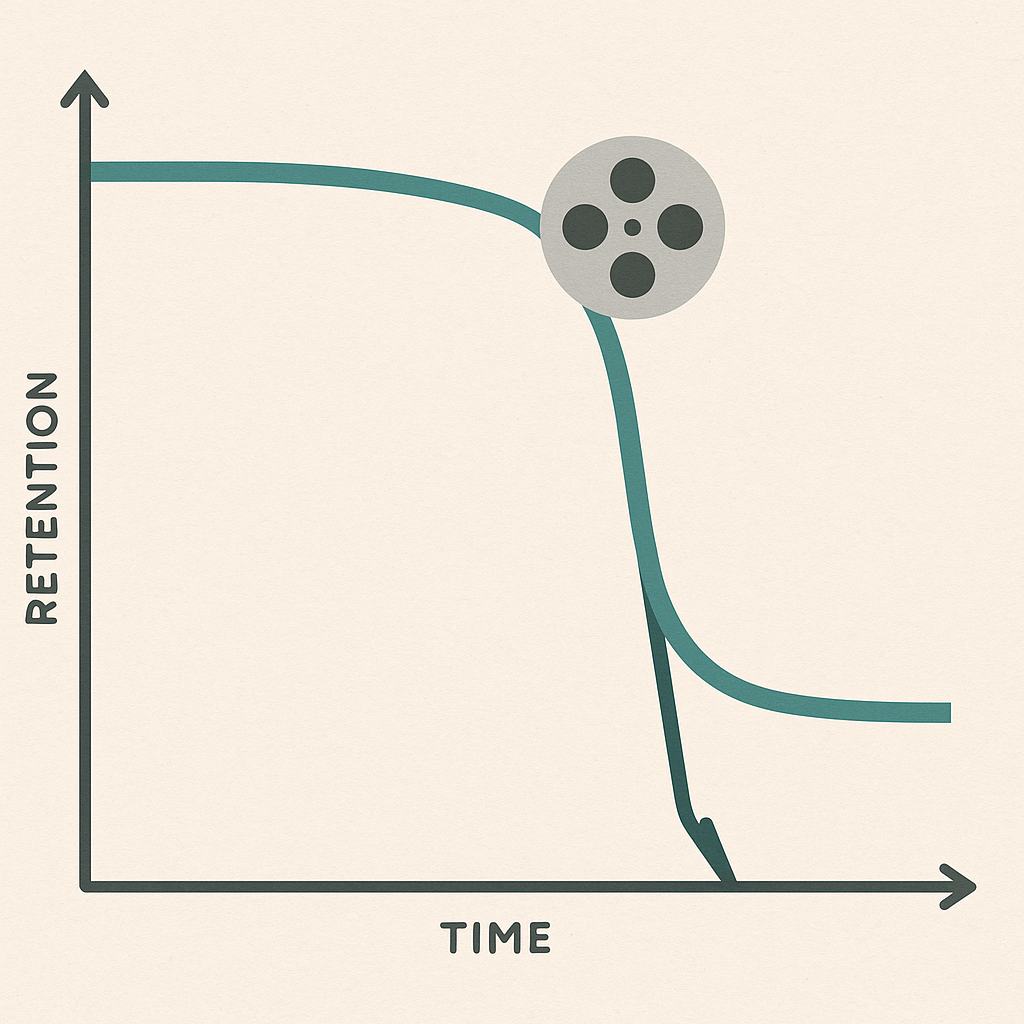
The retention curve told the story in detail. About 38 percent of viewers were gone by the four-second mark. By eight seconds — right around when the voiceover was supposed to begin landing — we were down to 22 percent. The viewers who saw the closing line, the one we had spent the most time on, were a small fraction of the people who saw frame one. The narrative arc we had built was being delivered to an audience that had already left the room.
What Analytics Actually Showed
When I pulled the metrics into a comparison view, the pattern across our last twenty videos became clear. The reels that performed well did not share a craft style. They shared a structural property: something interesting happened in the first three seconds. Not just visually interesting — information-bearing. The viewer learned something or saw a moment of motion or tension that gave them a reason to stay.
The reels that underperformed shared a different property. They all began with what classical editing would call setup. Establishing shots. Atmospheric openings. Slow zooms into the subject. By craft standards, these openings are not flaws. They are conventions, used in every well-made narrative video ever produced. By platform standards, they are a leak — every second of setup is a second the viewer spends deciding whether to scroll.
I started reading Instagram Insights and Meta Business Suite more carefully after this. Retention curves, completion rates, and the specific drop-off timestamps tell you exactly where your edit lost the audience. Most editors I know — including, until recently, me — look at the topline numbers (views, likes, saves) and not the curve underneath them. The curve is where the actual lesson lives. [BACKLINK PLACEHOLDER → external: Meta Creator Studio's guide to retention analytics, or Wistia's research on video engagement curves. Both align with the $4–8 CPC on video analytics tools.]
The Four-Second Cliff
There is a specific pattern in short-form retention curves that, once you see it, you cannot unsee. Most videos show a sharp drop in the first three to four seconds (viewers deciding whether to engage at all), a second smaller drop somewhere between five and eight seconds (viewers deciding whether to invest further), and then a more gradual decline through the rest of the runtime.
The first drop is unavoidable. A meaningful percentage of every video's audience scrolls past in the first second regardless of what the video does. That is the nature of feed behavior.
The second drop — the four-to-eight-second cliff — is where most editors lose their audience without realizing it. This is the moment where a viewer who has already chosen to look at your video decides whether the content has paid off the attention they have given it. If frame one promised something and frame six has not delivered any payoff, they leave. They are not being impatient. They are responding to a piece of content that has not yet earned the attention it has been given.
The reel I was proud of leaked precisely at this moment, because the structure I had built deliberately delayed the payoff until the second half. Classical narrative editing rewards patience. The short-form feed punishes it. This is the same pattern behind the work you're proudest of rarely being the work that wins.
What We Changed
Once I understood the pattern, the editorial change was structural rather than stylistic. We did not start making "worse" videos. We started making differently-structured ones.
The first change was to move the most interesting visual moment of every video into the first three seconds, regardless of where it lived in the original narrative arc. If the video had a moment of motion, a surprising visual, or an emotionally specific shot, that moment now opened the video rather than closed it. The narrative still resolved by the end, but the hook was no longer dependent on patient viewing.
The second change was to compress the voiceover front-loading. If the voiceover used to begin at the eight-second mark, it now began in the second or third second, often with the most provocative line of the script delivered first and the setup contextual information delivered later. This is the opposite of how a screenwriter would structure a 30-second narrative. It is also what the platform's retention curves clearly reward.
The third change was harder, and it took me longer to accept. We stopped making establishing shots. Every video now opens on the subject already in motion, mid-action, mid-frame. There is no breath before the work begins. This is not a craft choice I would defend in a film school classroom. It is, however, what the retention data unambiguously shows works on a short-form feed.
The results came quickly. Within six weeks, our average retention curve had shifted measurably. The four-second drop-off was smaller. The eight-second drop was less steep. Total reach increased because the algorithm rewards videos that hold attention, and we were now holding it. [BACKLINK PLACEHOLDER → external: a specific analytics platform's blog on retention optimization, e.g. Hootsuite, Sprout Social, or Iconosquare. Reinforces the $4–8 CPC keyword cluster.]
The Harder Lesson About Craft
The reason this is hard to write — and the reason almost nobody publishes this kind of post-mortem — is that it requires admitting that the version of craft I was trained on is not the version of craft the platform rewards. Every editing convention I absorbed from watching feature films, documentaries, and award-winning commercials applies imperfectly or not at all to a vertical feed video viewed for nine seconds on a phone in a queue at the grocery store.
This does not mean craft is dead. It means craft has to be redefined for the medium. The best short-form editors I have studied recently are not making worse films. They are making different films, with structural rules that respect the actual behavior of the audience watching them. Their opening shots earn attention. Their pacing front-loads information. Their endings reward replay rather than emotional resolution. None of these are craft compromises. They are craft adaptations.
The mistake I was making for two years was applying narrative editing conventions to a medium that does not behave like narrative content. I was making the videos I was trained to make instead of the videos the platform was rewarding. The cost of that mistake was paid in retention, reach, and ultimately in client results. It is the same misreading of signals that chasing new customers while the best ones leak away describes. [BACKLINK PLACEHOLDER → internal: link to article #4 (fast-approving clients) — both deal with misreading signals that look fine but quietly fail.]
What This Means For How Editors Should Think
The actionable takeaway from this experience is not a new editing rule. It is a habit. I now watch the retention curve of every video we publish, not just the topline metrics. I look at where the drop-off happens. I compare it to other videos we have made. I ask the team to do the same. The curve is a feedback signal the industry has been ignoring in favor of the easier-to-read but less informative top-of-funnel numbers.
The other habit is harder. I have learned to be suspicious of my own pride in an edit. The videos I am most proud of are not, on average, the videos that perform best. The correlation is not zero — sometimes craft and performance align. But it is much weaker than I assumed, and the assumption that "I think this is great" reliably predicts "the audience will engage" has been one of the most expensive assumptions I have made as an editor.
The cure is not to abandon judgment. It is to triangulate judgment with data. Watch the curve. Compare it to past work. Update the editorial intuition based on what is actually happening, not what you think should be happening. [BACKLINK PLACEHOLDER → internal: link to article #1 (content gap / three-week silence) — both articles deal with the discipline of reading signals correctly rather than relying on assumption.]
🎬 Embed a short walkthrough of an Instagram retention curve, identifying the typical drop-off points and what they reveal about editorial structure.
If this post-mortem resonated, you can find more of our ongoing work on YouTube and LinkedIn.