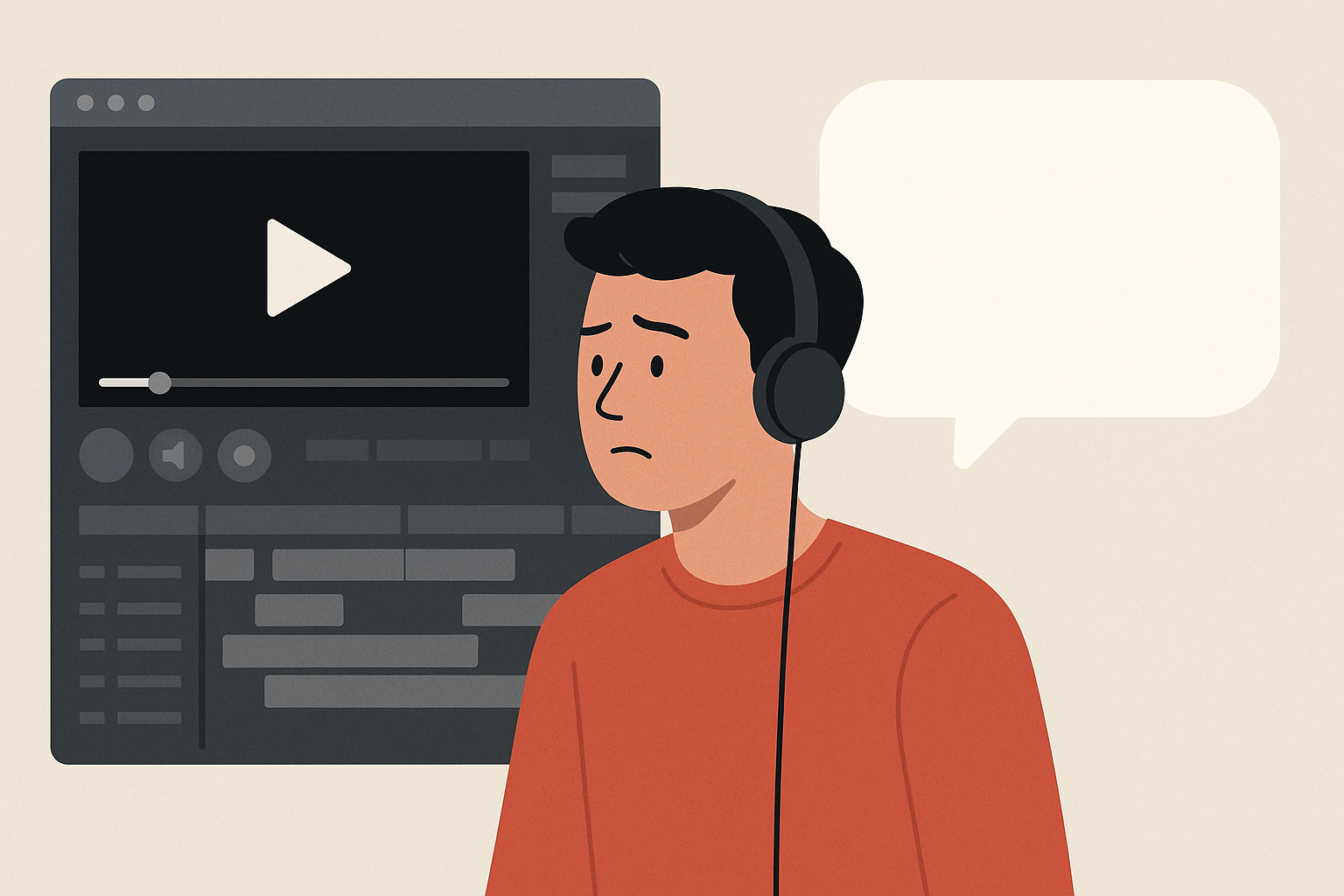


There is a moment, in almost every edit I have made for the last three years, when my hand hovers over the music track and considers cutting it. The visual is strong. The cut lands on a face, or a gesture, or a held shot that has its own internal weight. The music has been doing its job — driving energy, carrying pacing — and for a few frames, I can feel that what the video wants is not more energy but a sudden absence of it.
I almost never cut the music. The few times I have, the result has been some of the most memorable work my team has produced. The fact that I have to consciously override an instinct toward continuous sound is, by now, more interesting to me than any of the videos themselves. The instinct is wrong, and I know it is wrong, and yet I still default to filling every second with audio because the entire short-form industry has trained me to.
This is a craft essay about silence. Not as the absence of sound, but as an active editorial tool — one that almost no one in the current short-form ecosystem uses, and one that the editors who do use it tend to produce the most distinctive work in their corner of the platform. There is a counter-movement growing quietly against the noise-default of contemporary editing. Almost nothing has been published about it. This article is my attempt to describe what I am noticing.
Key Takeaways
- Silence is not the absence of sound. It is a sound choice — and one of the most powerful ones available to an editor. Used deliberately, it creates tension, redirects attention, and produces moments viewers remember.
- The industry's noise-default is psychological, not technical. Editors fill audio because music is a safety blanket that covers weak pacing, not because viewers demand it.
- The "autoplay on mute" assumption is outdated. Reels, TikTok, and Shorts all autoplay with sound on by default now, which means deliberate silence is more audible than it has been in years.
- Silence requires stronger visuals to work. Music can disguise a weak cut. Silence cannot. This is exactly why most editors avoid it — and exactly why the editors who use it well stand out.
- The technique is not "use silence everywhere." It is "earn silence at the moment of highest visual weight." Used wrong, silence reads as a mistake. Used right, it is the single most memorable moment in a short-form video.
Why Editors Are Afraid Of Silence
The fear is not irrational. It comes from real experience. Most editors who have published short-form content have, at some point, seen a video with a quiet section underperform — drop-off at the silent moment, comments asking if the audio was broken, completion rates that visibly dipped. The instinct to fill every second is learned, and it was learned for a reason.
But the lesson most editors have taken from those experiences is the wrong one. The problem in those underperforming videos was almost never that there was silence. The problem was that the silence was not earned. A quiet moment with no visual weight behind it does read as a mistake, because there is nothing for the viewer to do with the absence. The audience interprets the silence as a technical failure rather than an editorial choice, because nothing about the frame is asking them to lean in.
Deliberate silence — silence that arrives at a moment when the visual is doing enough work to hold the viewer's full attention — does the opposite. It pulls the viewer closer to the screen. It signals that something important is happening and the editor trusts the image to carry it. The autoplay environment, where most viewers encounter the work with sound on by default, means that silence registers immediately and clearly.
The fear is not of silence itself. It is of having a visual that is not strong enough to survive the silence. That fear is honest, and it is the actual reason most editors choose to fill every moment with sound. Music is a safety blanket. Silence forces a kind of editorial confidence most of us have not yet developed. [BACKLINK PLACEHOLDER → external: a credible piece on the role of silence in narrative film, e.g. from No Film School, Studiobinder, or Film School Rejects' technical writing.]
What Silence Actually Does To Attention
When music drops out of a video, something specific happens to the viewer's cognitive state. Several decades of research in attention and perception support the same finding, in different forms: the sudden change in auditory stimulus causes a measurable spike in attention to whatever the viewer was already perceiving. The brain, which had been processing the music as background, is suddenly freed to focus on the visual layer with a sharpness it could not access while sound was filling the frame.
This is why silence in film is so often used at the moments of highest narrative weight. The famous beach landing sequence in Saving Private Ryan uses sustained audio dropout to make the visual horror more, not less, intense. Christopher Nolan's films frequently contrast cacophonous sound design with sudden absences to direct emotional emphasis. Apple's product films use brief moments of audio absence to land the moment when a feature is named or a product is revealed. The technique is consistent across decades and formats: when the visual is doing the heavy lifting, the audio should get out of the way.
Short-form content has not yet absorbed this lesson at scale. The default mode of editing for a feed is to add — to keep adding music drops, sound effects, beat synchronization, and voiceover until every available second is covered. The result is a visual culture in which sound carries the pacing and the image often becomes a passenger. This is the inverse of what silence does, and it produces work that is energetic but rarely memorable.
A video that uses silence at the right moment is making an editorial argument: here is the thing you should remember. The argument lands because nothing else is competing for the viewer's attention at that moment. [BACKLINK PLACEHOLDER → external: research on attention and audio salience, e.g. from Wistia's research blog, Vidyard, or an academic perception journal summarized in a creator-focused publication.]
The Autoplay Myth
There is a piece of conventional wisdom in short-form editing that I encounter constantly and that is no longer true. The wisdom says: most viewers watch with sound off, so audio decisions do not matter that much. This was true for a period of platform behavior, roughly 2016 to 2020, when Instagram autoplayed muted and viewers had to actively unmute videos. It is not true now.
Reels, TikTok, and YouTube Shorts all autoplay with sound on by default. Most viewers in 2025 and 2026 are encountering short-form content with audio audible from frame one. This changes the calculus of audio decisions completely. Silence is not invisible the way it was when most videos played muted. It is one of the most audible choices an editor can make, because in a feed of sound-saturated competing content, the video that suddenly goes quiet is the one that announces itself.
This is the strange paradox of the current moment. The platforms have shifted toward sound-on viewing, which makes audio decisions more important than they have been in years, and yet most editors are still operating with the muscle memory of the muted-feed era. The opportunity is open. Almost no one is using silence as a deliberate tool because almost no one has updated their internal model of how audiences encounter the work.
When Silence Works And When It Fails
The technique is not "use silence everywhere." Used wrong, silence reads exactly the way it used to — as a mistake or a technical failure. The difference between silence that works and silence that fails is almost entirely about visual weight.
Silence works when the frame is doing enough on its own to hold attention. A held shot of a person's face mid-thought. A product revealed cleanly against a high-contrast background. A gesture, a glance, a sudden change in subject position. These are all moments where the image has internal weight, and the silence amplifies that weight rather than competing with it.
Silence fails when the frame is doing setup work — establishing context, transitioning between subjects, or showing something the viewer cannot yet interpret. In these moments, the absence of audio leaves the viewer with nothing to anchor to, and the silence reads as dead air rather than editorial emphasis. The cure for this is not adding music back. It is recognizing that the moment was not strong enough to carry silence and recutting the frame, not the audio.
The honest test, when deciding whether a moment can hold silence, is to mute the music in the edit and watch the section without sound. If the visual is interesting without audio, the silence will work. If the visual feels empty without audio, the silence will fail — and adding music to compensate is treating the symptom, not the cause. [BACKLINK PLACEHOLDER → internal: link to article #8 (well-edited video that failed) — both pieces are about diagnosing weakness in a cut by changing what you remove rather than what you add.]
How To Actually Use It
I do not use silence often in our work. When I use it, I use it at one of two specific moments in a short-form video, and the technique is structural rather than stylistic.
The first moment is the visual reveal. If the video has a hero moment — a product, a face, a single shot the entire video is building toward — I cut the music in the half-second before the reveal and let the reveal land in silence. The audio resumes a beat or two after the visual has registered. This produces a tension-and-release structure that the viewer feels without being able to articulate.
The second moment is the close. If the video has a final line of voiceover or a final visual, I let the audio drop out before the very last beat, so that the closing frame plays in silence for a half-second before the video loops or ends. This is the moment most editors fill with a music swell. The silence does the opposite of what the swell does, and it is, in my experience, far more memorable.
Both techniques work because they invert the audience's expectation. The viewer has been trained by thousands of videos to expect continuous audio. The video that breaks that expectation, at the right moment, produces a small surprise that sharpens attention. The attention is then immediately rewarded by the visual that arrives in the silence.
The cost is that this only works if the visual is strong enough to carry the moment. Which is the entire point of why most editors do not do it. [BACKLINK PLACEHOLDER → internal: link to article #1 (content gap / three-week silence) — wordplay opportunity, both pieces are about how absence functions as signal.]
What This Means For Audio Decisions More Broadly
Silence is the extreme case of a broader principle: every audio choice in a short-form video should be a deliberate decision, not a default. The reason most short-form content sounds similar is that the audio decisions have been delegated to platforms like Epidemic Sound, Artlist, Mubert, and Soundstripe — all excellent services — but treated as a final step rather than an editorial layer. The music gets added at the end, chosen quickly from a library, and dropped under the video to "give it energy."
This is not wrong. It is just incomplete. The editors I have studied most carefully treat music selection as one of the first decisions, not the last. They build the edit to fit the music's emotional structure, and they leave space for the music to breathe — including, sometimes, leaving space for the music to leave entirely. The audio is not a layer on top of the video. It is part of the structure of the video.
Silence is the rarest and most disciplined version of this thinking. It is the editor saying: at this moment, no sound is the right sound. Almost nobody has the confidence to make that call. The ones who do are the ones whose work I keep returning to study.
🎬 Embed a short comparison clip showing the same visual moment edited with continuous music versus with deliberate silence at the visual peak.