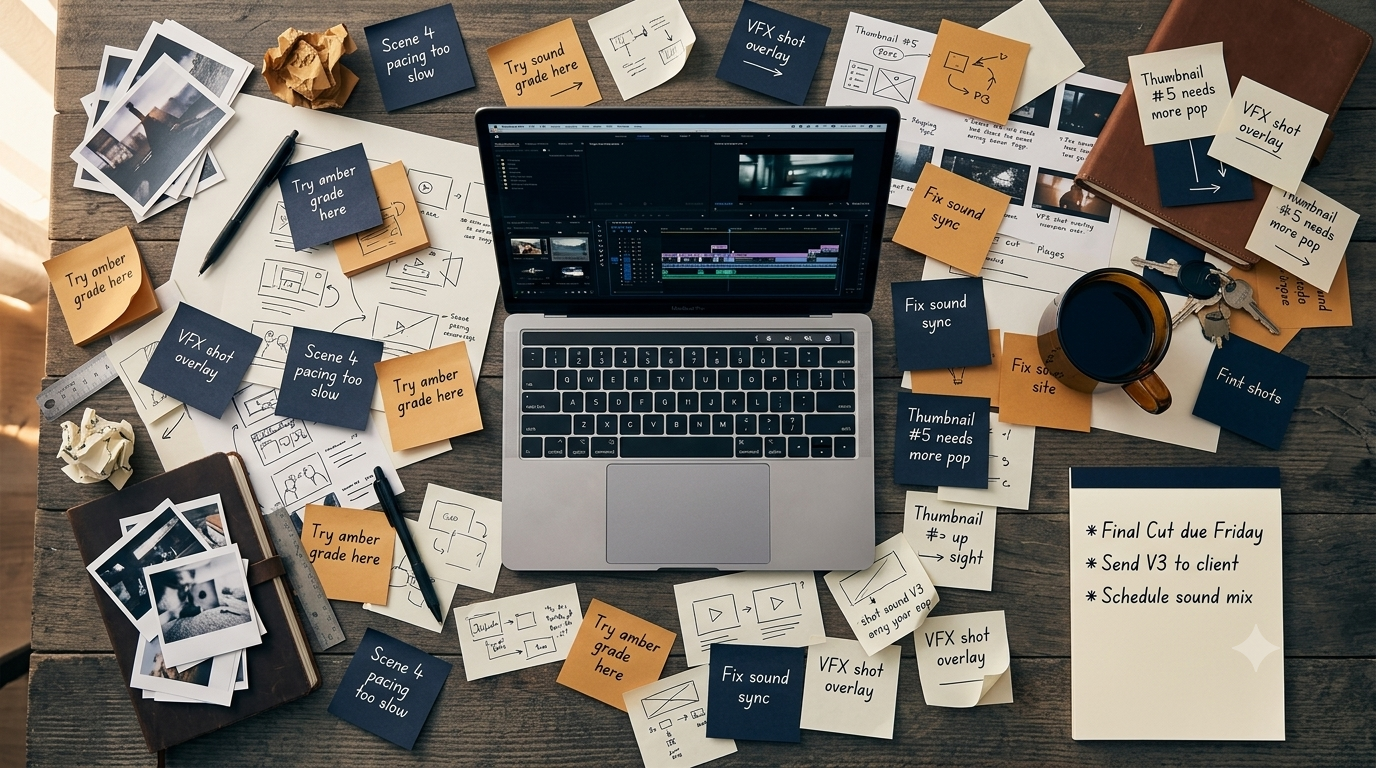

A brief landed in our inbox last quarter with forty-seven reference videos attached. The client was a thoughtful, intelligent founder who had spent two weeks personally curating them. There were YouTube ads, TikToks, Reels, brand films, indie short films, and three commercials from luxury watch brands that had nothing to do with the actual product. The cover note read: "Want a vibe somewhere between these — you'll know what I mean."
We didn't. And neither, as it turned out, did the editor.
The first draft came back two weeks later. It was technically competent and emotionally hollow — a video that visibly tried to honor every reference and ended up resembling none of them. The client was unhappy. The editor was demoralised. We had hit something that almost no creative-brief article on the internet talks about: the point where more references stop helping and start actively destroying the work — the same failure mode we documented in The Brief That Arrived With 47 Reference Videos. Every guide tells you how to write a better brief. Almost no one writes about what happens when the brief itself becomes the problem.You Probably Don't Have a Marketing Problem). When references contradict each other, the editor tries to merge incompatible styles, producing a video that feels stitched together rather than directed.
The 47-Reference Brief: What Actually Went Wrong
To understand why over-briefing breaks creative work, you have to understand what a reference is supposed to do. A reference is not a target. It is a signal. It says: "There is something in this video that resembles the direction I want." A good brief identifies what that something is — the pacing, the color grade, the rhythm of cuts, the emotional register — so the editor knows which signal to extract.
When a brief contains forty-seven references with no annotation, the editor receives forty-seven signals with no key. Some are about pacing. Some are about mood. Some are about typography. Some are about something the client noticed for two seconds and couldn't articulate. Without annotation, every reference becomes a full-style mandate, and the editor is left guessing which element of which video to honor.
The result is what we now internally call the 47-Reference Problem: a video that looks like it was made by a committee of seventeen people who never spoke to each other. Every choice is defensible. None of them are coherent.
The Psychology of Over-Briefing: Why Clients Do It
Over-briefing is almost never malicious. It is a symptom of three psychological dynamics that show up in almost every over-briefed project.
Dynamic 1: Anxiety Translated Into Volume
The client is anxious about the outcome. They want the video to be good. They don't know exactly what "good" looks like, so they substitute volume for clarity — if I send more, the editor will have a better chance of finding the right thing in there. This feels responsible. It is actually the opposite. The editor's job is not to find the right thing among the references; it is to execute against a clear direction. When the client outsources the direction-finding to the editor by sending forty-seven options, they have not made the editor's job easier. They have made it impossible.
Dynamic 2: Indecision Hiding as Thoroughness
When a client cannot decide between two creative directions, they often send references for both, hoping the editor will somehow merge them. This is the indecision hiding inside the brief. The client looks thorough. The brief looks comprehensive. The reality is that two incompatible directions have been disguised as one, and the editor will spend the entire project trying to reconcile a contradiction the client never resolved.
Dynamic 3: The Belief That More Information Lowers Risk
This is the most well-meaning of the three. Clients assume that giving the editor more information reduces the risk of misunderstanding. In any other context, this would be true. In creative work, it backfires — because creative execution requires editorial judgment, and judgment requires a defined creative space to operate inside. Too many references collapse that space. The editor stops directing and starts averaging. Averaging produces the visual equivalent of beige.
The Editor's Brain on Choice Overload
Here is where the psychology gets interesting, and where the counter-intuitive case for fewer references becomes defensible.
In 2000, psychologists Sheena Iyengar and Mark Lepper ran what became known as the "jam study." They set up two displays at a grocery store — one with 6 jam varieties, one with 24. The larger display attracted more attention. But shoppers exposed to the smaller display were ten times more likely to actually buy something. More options drew more interest but produced worse decisions.
This effect, popularised by psychologist Barry Schwartz as the Paradox of Choice, has been replicated across dozens of contexts. The mechanism is simple: every additional option requires cognitive processing, comparison, and evaluation. Beyond a certain threshold, the cognitive cost of comparison outweighs the benefit of having more to choose from. Decision quality drops. Decision fatigue rises.
[BACKLINK PLACEHOLDER → suggestion: external link to Barry Schwartz's "Paradox of Choice" TED talk or Iyengar & Lepper's jam study summary on The Decision Lab]
A creative editor parsing 47 references is in exactly this state. They are not "inspired" by abundance. They are paralysed by it. Each reference demands a decision: Should I honor the pacing of #3, the grade of #11, the cut rhythm of #28, or the typography of #41? Multiply that across the dozen technical decisions in any edit, and you have a combinatorial explosion that no human can resolve cleanly. The editor's judgment — the very thing you hired them for — is the first casualty.
There is a nuance worth naming. Research on creativity shows that some expansion of options can increase creative output. The relationship is not linear; it is an inverted U. A few references inspire. Too many overwhelm. The point where the curve turns downward is somewhere around five to seven references for most editors, depending on how clearly each one is annotated.
The Frankenstein Edit: When References Contradict
The most expensive consequence of over-briefing is the Frankenstein edit — a video assembled from incompatible stylistic limbs.
Imagine the 47-reference brief includes:
- A fast-paced TikTok-style ad with jump cuts every 0.8 seconds
- A slow, contemplative luxury watch commercial
- A handheld documentary-style YouTube vlog
- A polished corporate brand film
Each is a legitimate creative direction. None of them belong in the same video. When an editor tries to honor all four — because the brief implied all four were valid signals — the result is a video that switches tonal registers every fifteen seconds. The pacing fights the grade. The handheld footage clashes with the polished branding. The product is a stitched-together creature that satisfies none of the references it was built from.
The client looks at the result and feels something is "off" without being able to name what. They send revisions. The editor adjusts. The video gets further from coherence, not closer, because the foundational problem was never identified: the brief itself contained a contradiction the client never resolved.
The Hidden Cost: Project Management and Time
Over-briefing is not just a creative problem. It is a project management catastrophe. Every additional reference adds review time, asset organization time, and revision time. Multiply this by the number of stakeholders involved, and the project's timeline doubles before the first cut is even attempted.
This is where the operational damage shows up. Teams using agency project management tools like Asana, Monday.com, or ClickUp suddenly find themselves logging reference files, building moodboard folders, and tagging Frame.io comments across dozens of inputs that should have been narrowed to five before the project began. The tool is doing its job. The brief is doing the opposite of its job. The cost is real, measurable, and almost never accounted for in the original project quote.
[BACKLINK PLACEHOLDER → suggestion: external link to a credible project management or creative operations resource, e.g., Frame.io's blog on creative review workflows, or Asana's creative project management guide]
The Right Number: What Actually Works
After years of watching this pattern repeat, the operational answer has become clear. A good creative brief contains:
Brief ElementOptimal RangeWhy
Total references
3–5
Below the choice-overload threshold for most editors
Annotation per reference
1–2 sentences
Tells the editor what to extract — pacing, mood, grade, cut rhythm — instead of asking them to guess
"Avoid" examples
1–2
Constraints sharpen direction more than additions do
Defined creative space
A single mood + tone + pacing register
Tells the editor where to operate, not just what to look at
Decision-maker named
1 final approver
Prevents the brief from becoming a committee-by-attachment
The clients who consistently get great work from us send briefs that fit on one page. Three references. Each one annotated with a single line — "the pacing here, not the color"; "the emotional register, not the visual style"; "the way the product is held in the first six seconds". That's it. The editor has constraints, signals, and creative space to operate inside.
The clients who consistently struggle send briefs with attachments numbered in the dozens. Every revision cycle, more references get added. The brief grows. The work gets worse. The pattern is so consistent it is almost predictive.
The Better Brief: A Four-Step Framework
If you are a client preparing a brief for an upcoming creative project, the following framework will save you weeks of revision time and produce better results:
Step 1: Resolve Your Own Indecision First. Before you write the brief, force yourself to pick one primary creative direction. If you cannot — if you genuinely want to consider two directions — say so explicitly: "We are choosing between Direction A and Direction B. Please show us a 15-second test of each before we commit." Naming the indecision is far better than disguising it as comprehensiveness.
Step 2: Cap Your References at Five. Annotate Every One. For each reference, write one sentence: what specifically do you want extracted from this? Pacing? Mood? Grade? Cut rhythm? Typography? The annotation is more important than the reference itself. An annotated reference is a signal. An un-annotated reference is a puzzle.
Step 3: Include "Avoid" Examples. Tell the editor what not to do. One or two clear "we don't want this" examples sharpen the creative direction more than ten "we want this" examples. Constraints clarify; additions confuse.
Step 4: Name a Single Decision-Maker. Before the project starts, name the one person whose feedback is final. Briefs that pass through five stakeholders, each adding their own references and revisions, produce the worst outcomes. [BACKLINK PLACEHOLDER → suggestion: internal link to your future article on "Why too many decision-makers kill creative projects" or similar — or, if available now, link to the in-house content decision article since both deal with decision-making structure]
A brief built this way is shorter, faster to write, and produces dramatically better creative output. Counter-intuitively, the less you send, the better the result.
🎬 Embed a short explainer breaking down the four-step better-brief framework with side-by-side comparisons of an over-briefed and well-briefed project.
The Wider Pattern: Why This Matters Beyond Briefs
Over-briefing is one specific instance of a broader operational pattern: the substitution of volume for clarity. It shows up in product specs that grow to forty pages and produce worse software, in marketing strategies that target eleven audiences simultaneously and reach none, in meetings where everyone speaks and no one decides. [BACKLINK PLACEHOLDER → suggestion: internal link to your content gap article — natural fit because both articles address operational patterns that fail despite looking responsible]
The underlying issue is the same: when we are uncertain about an outcome, we instinctively add more — more material, more participants, more options — because adding feels like reducing risk. In reality, adding usually increases the cognitive load on whoever has to execute the work, which lowers the quality of execution, which increases the risk we were trying to avoid.
Recognising this pattern in the brief is the first step. Recognising it across your operations is the harder, more valuable second step.
If you want more on building creative work that survives contact with clients, subscribe on YouTube or follow along on X.